
Genre : Drama, Mystery, Romance, Thriller
Director : Neil Burger
Music : Philip Glass
Cast : Edward Norton, Paul Giamatti, Jessica Biel, Rufus Sewell
Release Date : September 1, 2006
Run Time : 110 min
Storyline:
A young boy in Vienna who is obsessed with learning the art of magic falls in love with a girl who belongs to Austrian royalty. Although the parents forbid them to see each other, they cannot be split apart. Until one day they were found together and separated, causing the boy to leave. He travels the world to learn all that he can of the magic arts. The boy comes back to Vienna, 15 years later, and becomes famous as Eisenhiem the Illusionist. During one of his shows, he meets up with Sophie, his childhood love, who is now the Duchess Sophie, engaged to the Crown prince of Austria, Leopold. When Sophie tells him that her engagement to the prince is not of her choice, and that she still loves him, Eisenheim plots to be with her, also undermining the power of the Crown Prince in the process.
Watch the Trailer
The Point is:
A wonderfully acted, nicely polished piece of entertainment, but not made with the passion and drama it deserves. It's hard to say exactly whats missing - the performances are very good, especially Edward Norton is amazing as well as Giamatti, it is entertaining in an old-fashioned, mystery type of way, and it's beautifully shot. But therein lies part of the problem - it's too beautiful...too old-fashioned...much like a movie that tries too hard to impress us with its image and cinematography, and not engage us enough with a strong story.
This film will not make cinematic history, win an academy award or even be lauded by the critics, but when compared to the majority of films out there right now, it stands out as good solid entertainment. It does what Hollywood does best, taking you away from all the tiresome simplifications of complex everyday worldly issues and letting you escape, enjoy yourself for an hour and fifty minutes.
It is a story of lovers, their struggle to be together - a story that has been told a million times (and counting...) and yet it never wears out. The acting is restrained, the lovers have good chemistry, the villain is sufficiently believable and evil, the hero is capable and the plot is refreshingly interesting. Burger has managed to make a remarkable film. There is a very consistent tone to the visuals, a foreboding dreariness that perfectly depicts the subject and the period. The illusions are captivating and almost believable, the orange tree trick was in my view, the highlight of the movie. The love story is understated, yet touching. And Eisenheim is a compelling, sympathetic hero, blessed with such unconventional talents that the entire movie feels fresh and alive. This is storytelling at its best. So forget about everything and just enjoy yourself. Go to the movies - at least this movie and walk out with that hard-to-suppress smile on your face. It's positively therapeutic.
Continue reading the full review of 'The Illusionist' after the turn.
Review: The Illusionist
I saw this wonderful film when I was bored out of my mind last Sunday, I just picked the DVD at random. And I'm glad I did. The entire film is beautifully shot and realized and while it doesn't promise to keep you thinking hard, you will be surprised towards the end. It was thoroughly entertaining and innovative. This movie has it all: romance, suspense, star crossed lovers, magic and supernatural illusions.
"The Illusionist" is a very unique film that combines three genres that have been used in a million movies : the lush period piece, the feel-good romance and the ever-at-crosses "AHA!" mystery thriller (a genre which M. Night Shyamalan has single-handedly destroyed recently). Yet, the final product is surprisingly fresh and entertaining. Captained by a first time director Neil Burger, this is a very liberal adaptation of a Steven Millhauser story about a magician in Victorian era in Vienna, Shot entirely in the Czech Republic at gorgeously befitting locations, this is a beautifully made period piece, complete with genuine turn-of-the-century illusions, a wonderful soundtrack, lovely cinematography and an intriguing story. "The Illusionist" was perfectly set-up to be a monumental disaster, but with a graceful slight-of-hand and much appreciated restraint, it ends up being quite an experience.
As with any period movie worth its salt, there's lavish attention to the very authentic set designs and costumes, representing the late nineteenth century Vienna. Even the horses are big, as were the breeds used back then. Director Burger puts a wonderful spin on the visuals with an acute attention to lighting (especially in the dreamily over-exposed flashbacks) and old fashioned camera techniques (witness the circular camera's eye closing to transition from scenes) to give the film the feel of being a fond memory of a classic movie from a bygone era. The entire movie actually flickers, like the lighting used in the film, lending a much enjoyed nostalgic feel.
The central romance plot where Edward Norton's Eisenheim the Illusionist and Jessica Biel's Duchess Sophie are star-crossed lovers separated by class and society, had all the makings of a snore-inducing cotton candy fluff. Crafted in an understated style that complements the greater plot, the movie ends up being anything but routine.
Edward Norton's performance was mesmerizing, as always. He has a soft, hypnotic voice that makes you want to listen to him. I bet if he makes a career shift to professional hypnotism, he'll make a killing. This man is in danger of being trapped by his own brilliance, as the audience will come to expect a masterful performance in every one of his films, which he unerringly delivers. He is perfectly cast as Eisenheim The Illusionist. His accent flows seamlessly and he simply disappears into the role, both in the scenes where he performs his magic for his audience and especially in the second half of the film when he turns into a man of very few words.
Jessica Biel, a former teen idol and TV star, at first seemed a horrific choice for this role, but she pulls of the trick. She looks quite breathtaking as the Duchess Sophie. Her performance as the woman trapped by social norms of the era, yet one who loves the Illusionist enough to risk it all is very convincing. She doesn't get to speak much, and she is there for only a few scenes, but Ms.Biel definitely puts in a very restrained performance.
Even better are Rufus Sewell as the tyrannical crown-prince Leopold and Paul Giamatti as the chief inspector Uhl. Using a short story as source material, characterizations always have the potential to be paper-thin, but these seasoned pros add terror, humor, and gravitas through their great skills where lesser actors would've been wooden and cold. The real revelation to me was none other than Paul Giamatti. Paul's richly accented role was very refreshing and his scenes with Norton, where he is full of respect and begrudging admiration for the Illusionist's skills, are very enjoyable to watch. The supporting cast also worked together very well utilizing their odd, vaguely European and aristocratic accent. Though it seemed to me that the actors, at times, lose their accents, it really didn't matter after awhile.
The most interesting part of the film, which made me a believer, right from the start, was that magic seemed possible. It seemed real. It rooted itself in the supernatural, but then, it failed to grow. It planted the seed of the magical orange tree in your mind and then forgot to water it. All this might be even more compelling if the actual romantic plot felt stronger. But despite the impeccable skills of Norton, who makes this rather bland character interesting, and the so-so presence of Biel, their characters aren't as interesting as the tricks and magical wonders that Eisenheim creates on the stage.
If anything, the film felt stronger and with better purpose and strength when Giamatti is on screen, trying to figure things out. By the end his own revelation is probably the biggest trick of all, almost Shyamalan-sized, yet I find his performance is what sticks with me as opposed to the twists and surprises thrown to the audience. It's almost as if the iron-clad conventions of the plot and the intensity, passion and creativity of what goes on in Eisenheim's total control battle it out for dominance. Also, the way Eisenheim brings down the Crown Prince seemed too easy, one might think that challenging the monarchy, especially in those times, would be a harder and more dangerous task.
A more over-eager director would have completely sabotaged the fantastic ending to "The Illusionist" and ruined the movie. Burger handles it all very deftly, the grande finale where "everything is revealed" is a wholly satisfying conclusion that rewards the patient viewer and fulfills the lofty promises of the themes presented throughout the work. "The Illusionist" boasts an excellent music score from minimalist composer Phillip Glass that easily rivals some of his greatest works. Norton and Giamatti indulge in some of the best "staring" scenes since the days of the silent movie. The look on Giamatti's face and the positioning of his eyebrows as he watches Norton perform his illusions, coupled with Norton's eyes as he pulls off his tricks are priceless.


 Although, as a film buff myself, having a whole Kill Bill epic in one sitting would've been satisfying, like the first part that was split, Vol. 2 works extraordinarily well.
In terms of storytelling it's direct and (of course) unconventional, in style Tarantino pays homage/borrows (or depending on your point of view steals) from most of the films that stew around in his arsenal.
The Story
What's there to say about the story, except that it picks up where it left off ? Sort of- as usual, the non-linear story aspect kicks in, and two sections of the film derail from the continuing story of revenge on the DIVAs and Bill (the squad members this time being the perfectly paced in tone and presence Michael Madsen as Budd, and Daryl Hannah's most vindictive role as Elle Driver). At first, we get a stark, black and white view of what the "Massacre at Two Pines" was like, and right away we're introduced (finally) to Bill, played by David Carradine, one of the most calm, affecting film villain performances in recent memory. The other derailment is to tell the immensely entertaining story of The Bride's training by the heavy-duty Pai Mei (Gordon Liu, in one of his performances in the whole KB saga). This could be counted as the funnest part of the film, aside from a few key moments, as the camera sweeps from medium to close up happen every thirty seconds or so.
The Good
"Vol. 2" is way different. It makes sense it's a separate movie; the tone is such a departure from "Vol. 1" in two ways. One is style. Director Tarantino has fun stylistically quoting Sergio Leone and chop-fu cheapos from the late 1960s and early 1970s. Cinematic sampling is something he's good at and enjoys, but in "Vol. 2" he doesn't go as overboard as he does in "Vol. 1." He pulls back and lets the plot breathe, rather than filling every spare second with a homage-cum-parody that maybe a dozen lucky fans will get. Maybe some here wish he'd pile it on a bit more, but they have to make do with the goofy Pei Mai sequence, which is a flashback and hence not jarring in its "Vol. 1"-style comic-book treatment.
Throughout "Vol. 2" the emphasis is on storytelling and character-building, which is where it should be given we are now being asked to deepen our commitment of interest to these people. "Vol. 1" is okay for what it is, but its flash and action are no match for the depth and nuance of "Vol. 2." This gets to the second different tonal difference between the films, which is emotional. It all comes back to the characters. They don't quite become real people here, but they get close enough to get under your skin. Admittedly, the opening part of "Vol. 2" tests the viewer's patience a bit, there's some long bits that show the director hasn't really mastered self-discipline, like with Thurman's graveyard struggle, but the meandering usually has a purpose.
Tarantino is building toward something here that has its payoff when Thurman's character finally has her face-to-face showdown with Carradine's Bill. From that moment forward to the end, this is the best Tarantino has ever been.
Carradine and Thurman dominate the proceedings with two of the finest performances I've seen, certainly the best Tarantino has directed, playing off the mythology we've been taught in "Vol. 1" and developing resonances with the viewer both together and apart which will surprise those expecting a casual butt-kicking affair. We finally find out what Carradine means in the first line of "Vol. 1" where he tells a whimpering victim he is being masochistic, not sadistic, and its a powerful revelation, that this sinister baddie may have a heart buried under that cold exterior. Carradine is perfect in his phrasing, his pauses, the tired glint in his eye, or the way he says "Kiddo." You can't ask for a better veteran performance.For her part, Thurman presents a brilliantly conflicted character who can not stop either hating or loving Bill, and brings us not into a world of cartoon anguish, but real human pain.
Once again the music plays a key factor in this movie, is very well selected and for every single scene the music fits perfectly, especially the grave break-out scene. And of course, the dialogue. In this movie, we get a lot more dialogue than brutal fighting like in Vol.1, this movie is more centered in explaining what led Bill to do what he did, it pretty much focuses in the past, explaining the whole thing. I especially liked the dialogues between Bill (Carradine) and The Bride (Thurman), I thought they were clever and just great, like all Tarantino's dialogues. Also the locations were excellent, I have no idea where they shot the film, but the landscaping was great, I truly liked it.
The Bad
"Kill Bill Vol. 2" is slow-moving, and needs "Vol. 1" in a way few sequels do, since it assumes you know nearly all the characters coming in. That's a weakness. So are some undeniably pointless bits, including the entire sequence with Bill's father figure, Esteban Vihaio, and some business at a bar involving Michael Madsen, who plays a former assassin now gone to seed. Madsen's good, though, and so's Daryl Hannah as another rather mouthy assassin, Gordon Liu as Pei Mei, and especially Perla Haney-Jardine as a girl named B.B. Also, the touted cameo of Samuel L. Jackson does not make any sense. He's not even noticed. The nice thing with Tarantino though, is for every scene that strikes a bum note, there's four or five that hit the right mark, and some manage to do much more. My favorite scene involves the one where the Bride claws her way out of a second hand grave after being buried alive, the background score in that scene is just beautiful. Still, it's the final moments of this film that will stay with you, as Bill and his former pupil work out their "unfinished business" and we are left to ponder the results of their decisions and actions.
The Point is... (Rating | 8.5/10)
You can safely conclude that Vol.1 was the Style, and Vol.2 is the Substance.
"Kill Bill Vol. 2" may not reach the heights of cinema to which it aspires, the level of "The Good, The Bad, And The Ugly" quoted in its score, but it's a fine film that will make most viewers glad they stuck around for the second installment. I am.
Scenes to Watch out for :
1) When Budd buries the Bride alive in a second hand grave after shooting her with rock salt and nailing her in a coffin. This has got to be one of the most suffocating moments in world cinema till now.
2) The Scene where the Bride and bill have their last conversation. Bill shoots her with a temporary paralysing agent and begins to explain the mythology behind Superman and its relevance to herself. Really good.
yours truly,
Ar'Nath
 Uma Thurman is the avenging angel in this long-awaited fourth film from Quentin Tarantino. Intense gory martial arts action rules the roost here.
Crime boss O'Ren-Ishii (Liu) paces the gallery of the House Of Blue Leaves, watching her subordinates take on The Bride (Thurman), a samurai-sword wielding blonde dressed in a natty, blood-stained yellow tracksuit. As The Bride disembowels and decapitates a dozen yakuza flunkies, pausing only to rip out the eye of one assailant to uncork another plume of blood, one wonders: what does all this mean for feminism?
The Story
The Bride is after vengeance. After taking a beating at the hands of her former colleagues from the The Deadly Viper Assassination Squad, the final bullet to her head is delivered by Bill, who also happens to be father of the unborn child. Waking from a four-year long coma, the Bride clutches at her empty womb and unleashes a feral howl. It is a searing moment from Thurman, who showed up to work on the film only two months after giving birth. What does this say? Hard to say, except perhaps that hell hath no fury like a heavily pregnant woman gunned down on her wedding day.
The Good
The first volume of Quentin Tarantino's Kill Bill sees women stalk one another as remorselessly as Sergio Leone's nameless gunfighters. Men hardly get a look in. The face of the titular Bill is concealed from us throughout. In place of machismo, we have a ferocious femininity - the snarl of a mother protecting her child. A different strain of aggression drives this action movie, maternal yet predatory. Tarantino riffs on this with his opening fight where the Bride and Vernita Green (Fox) break off from their knife duel when Green's daughter returns from school. A self-conscious interweaving of numerous exploitation genres - in this volume, the influence of Japanese samurai movies and the ultra violence of Takeshi Miike (Ichi The Killer) are particularly strong - unfortunately one also thinks of McG's Charlie's Angels films. Superficially, at least. What with all these kick-ass chicks and Lucy Liu strutting her stuff. In fact, Kill Bill is the anti-Charlie's Angels. It is a deliberate riposte to the cartoon kung fu, lukewarm Matrix leftovers, and shoddy CGI - what Tarantino dismisses as all that "computer game bullshit" - that Hollywood has been dallying with while the director was away.
Where McG's franchise speeds you through its incompetence, Tarantino dawdles to shade in more characterisation, to fill in back story, to embellish every inch of the plot before marking it with a signature flourish. The director of the 90s is back and he might as well have signed the right hand corner of every frame. Tarantino pulls no punches, creating, as one critic put it, `The most violent film ever released by an American film distributor'. Squirting blood and flying limbs abound, but the director does it all with a breathtaking sense of style. We witness one sword-dance in silhouette, one in black and white, one over a beautifully filmed snow-covered Japanese garden, and even a sequence in Anime. `KB's story is minimal, but Tarantino's aim is style: Sergio Leone, Cheh Chang and Bruce Lee are all paid homage, and then gracefully outdone.
The soundtrack, primarily Japanese artists performing American styles, is haunting: Tarantino breaks form by not using well-known American classic rock (who could forget being `Stuck in the Middle' of Mr. Blonde and a helpless cop?), but by doing so sets the perfect mood of the film. They're songs we've never heard before, but feel strangely connected to. `Kill Bill' is a testament to Tarantino's ability to take the craft of his idols and make it his own, mixing classic cult film style and mixing it with his own wicked sense of Cool. Not for the faint of heart or anyone looking for a `feel-good' film, but `Kill Bill' is at the very least an instant classic.
The Bad
Unfortunately, he is so brimming with ideas and ambition that his film had to cut in two to meet the needs of distributors. Miramax took this course of action rather than edit their one-time wunderkind. An unsympathetic studio might have trimmed the extended anime sequence about O'Ren-Ishii's troubled childhood, for example, although this is an intense treat depicting events almost too agonizing and heartbreaking to witness in live action.
One aspect of this movie that puzzles me is the emphasis it's critics make of the gore. For my part the gore was so outlandish it's hard for me to see how anyone could take it seriously, and that was part of the appeal. Buckets of blood spraying 15 feet in the air is so beyond the realm of reality how could you possibly take it seriously? For my part it was borderline comical and really brought out the flavor of the scenes, rather than being their focus. And regardless of what you think of Tarrentino as a director, the man is bar none the best at matching musical scores to a scene in the business.
Kill Bill arrives at a moment in mainstream movies - between the second and third Matrix films, before the final part of The Lord Of The Rings trilogy, ahead of another bloated Harry Potter installment - where Hollywood is willing to test the bladder strength and patience of its audience like never before. Whether it is the fashion for director's cuts or DVD deleted scenes, it is a contemporary truism that art is best served if the excised portions are restored. With this spirit in mind, the dividing of Tarantino's epic into two volumes may be seen as a victory for integrity. However, cynics may suggest that numerous installments mean punters shelling out more times for the same film, both in the cinemas and again for the various extended DVD editions. Whichever way you want to slice it, this is only half a film. Though it contains many pleasures - and it's great to see such an influential director returning with such a stylistically exuberant work - it is missing the classic satisfying element of any story: an ending.
The Point is... (Rating | 8/10)
A blood-stained love letter to exploitation movies that seems to be missing a few pages.
However, you must watch the movie at least for the following scenes :
1) The scene where Oren and the Crazy 88 enter the House of the Blue Leaves. Absolutely magical. The score, the pacing, the atmosphere....simply magnificent. The slow motion pull away and the obvious hierarchy of characters, Lucy Liu was absolutely made for that part and that part was made for that scene. The beautiful and menacing Gogo Yubari and the goofy 88s trailing behind. You can also feel the tension the owners feel at having such esteemed guests but one's who admittedly exude as much fear as they do respect. Add to this the nameless, faceless people dancing who are oblivious to the regality (and lethality) of Oren's entourage.
2) Oren is called out by Kiddo who subsequently whacks off Sophie's arm in a highly symbolic gesture. Words can't describe how moving that scene is. The score is superb and the timing is nothing short of perfect. I especially love the way the crowd pauses after the arm slicing...like they're all stunned or still convincing themselves it really happened...then all rush out screaming. Kiddo makes a slow, deliberate plod through the panicked crowd, a march to destiny filmed from several perspectives that combine holistically to give the segment a life of it's own.
yours truly,
Ar'Nath

Definitely one of the better movies of 2006......I think.
Pursuit of Happiness, is directed by Gabriele Muccino, written by Steve Conrad and starring Will Smith. I was touched at the range of emotion, entirely engrossed by the story and completely drained by the end of the film.
The Story
Set in the 1980's in San Francisco, Will Smith portrays Chris Gardner, a father struggling to sell a doubtful medical machine, with dreams of giving his family a better life. On what would seem like a whim, he decides to try to be a stock broker. In order to get the job he has to take an unpaid internship that has little promise of panning out to a job at all. He is months behind on the rent, he hasn't made a sale in a long time but he decides to do the internship anyways. During the internship he and his son can no longer pay the rent and they become homeless.
Gardner is a conflicted character. He wants to improve his family's life but in order to do so he has to risk everything and make their lives harder for a while. There is also no promise of a job if he takes the risk. His wife eventually tires of working double shifts and perceives his aspirations as a fool hardy pipe-dream. Linda, played by Thandie Newton, is tired, frazzled and hopeless. She can no longer see the light at the end of the tunnel. Gardner's last scheme had eaten up their entire life's savings. In a fit of selfish anger she leaves for New York and abandons both Gardner and their son, Christopher.
The Good
The story reminds me of Erin Brockovich and is just as touching. Writer Steve Conrad quilts a story of pain, doubt and fear but lines it with a radiant hope. An actor can only be as good as his script and Conrad gives each actor an opportunity to shine.
My hat off to Gabriele Muccino for taking the risk of a light internal narration and making it truly work for this film.
Will Smith's painful scenes are exhaustively powerful. This film required a girth of emotion unrivaled by any of his previous films and Smith does not disappoint. In one scene the script requires an emotional gamut that runs from hopeful, hopeless, silly, tired, exhausted, and eventually to depression. He holds together this scene that could have easily fallen into melodrama with delicate precision. I felt the weight of his physical burdens throughout the movie. A scene that takes place in the Subway station's toilets, is particularly moving. Smith's transformation to "A" list actor is complete.
Thandie Newton plays Linda, Gardner's wife. Newton portrays Linda's justifiable anger with passion and control. She makes Linda more than just a selfish wife who runs off but rather a character so exhausted by being let down that she doesn't want to take it anymore. I felt for Linda because Newton was so exhausted looking and maxed out feeling. Newton is an amazing actress who proves again that her acting is a reason to see a movie.
Jaden Christopher Syer Smith plays Christopher, Gardner and Linda's son.
Often you have to rate a child actor on the "child actor" scale but Jaden can be judged on the traditional actor's scale. He did an exceptional job in this roll. This movie was demanding emotionally on all the characters but Jaden captures the instability so damaging to children in these situations. He also does an incredible job of giving hope to the film. I can't wait to see how he matures as an actor. Numerous movies have been made about women who struggled to get by. I was impressed that this film could touch me and that I could relate to a father's struggle as well.
In Pursuit of Happiness is a powerfully written and acted film. Every scene has an emotional subtlety and expressiveness that touches the audience in a personal and intimate way. I might just see this one again.
My only problem is this. Will Smith had a son. He had a responsibility to his son and appeared to be a good father in the film that would do anything for him and so was prepared to sacrifice everything for him, including living in a homeless shelter. I cannot understand, if this story is indeed true, how can any father risk everything including his son for the sake of his dreams? Surely he could have left his son with his wife whilst doing the unpaid internship and if everything succeeded as it did then he could get his family back. And it was America, the land of opportunities. He could have gotten a part time job, at least.....a job to do after his internship hours, something like the way that his wife seemed to be doing. If he really wanted to pay for the rent and food, there were a thousand possible ways to do that while still pursuing his "Dream Job". That is how people get by in the real world. I just fail to see how the message of risk everything can be a good one when you have responsibilities to your children. One should never put one's own ambitions above the need's of one's family.
But then, this is Hollywood. An Hollywood Drama, "Real-life" or not, will always find ways to exaggerate the struggles of the lead characters, when there are, right before their eyes, any number of means to lessen their burden. That is because, all that drama is needed to maintain the effectiveness of the movie. Lets face it, this movie was made clearly for that golden statue, the Oscar. Whatever the fate of the movie, Will Smith truly deserves at least a nomination.
The Point is... (Rating | 6 out of 10)
Watch the movie, definitely worth your time. Though somewhat overtly dramatic, a truly moving essay.
Yours truly,
Ar'Nath
 This is about the latest Hollywood blockbuster named quite to the point, as "300". It is based on a stupendous comic book series by the same name, the creator of which , is the absolutely brilliant Frank Miller. Now, you may have seen another recent movie which based on one of Frank Miller's creations - "V for Vendetta". This movie "300", is being criticized mercilessly for the sheer amount of historical facts being changed at will. But, if you ask me, i just don't care. When you experience the brilliance that is this film, any argument against the movie will just be a moot point. I have never seen anything like this before - the colors, the characters, the music, everything takes you to a whole new level of film making. Ladies, you may not like this movie very much, but the Men, will simply love it. The sheer aggression that is shown in the movie, the action, SFX, the fantastic one-liners, and not to mention- the amount of blood that spills, will surely overwhelm your senses. Now, it will soon be released in India, but i wouldn't recommend watching it in the theatres. Thanks to the Indian Censor board, the movie will be so censored and filtered that, by the time it finally makes it to the big screen on the Indian multiplexes, it would look like you were watching a kiddie movie. Then again, since the entire movie is like one big bloodbath, it probably wouldn't make it past our sappy censor board.
The USP of the movie "300" lies in its aggression, its grisliness. If that is edited out, then it is not worth watching at all. You would do better to get hold of the unedited version of the DVD. Now watch the trailer, i will not say anything more.
Watch the trailer
The Story
At the pass of Thermopylae in 480 B.C., 300 Spartan soldiers under King Leonidas held off the huge Persian army under Xerxes for a couple of days -- just long enough for the rest of the Greek city states to assemble an army to match the Persians. The Spartans died to a man, but their resistance kept the Greek Peninsula from being overwhelmed by the invaders. Frank Miller based his graphic novel on this famous last stand.
-----------------------
yours truly,
Ar'Nath
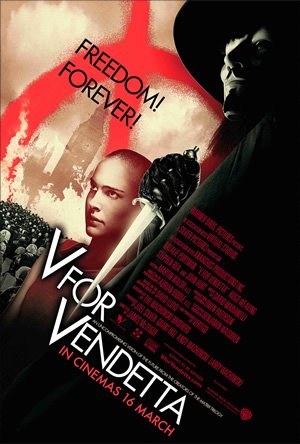 A classic, if there ever was one.
Tagline : Remember remember, the fifth of November.
"Voilà! In view, a humble vaudevillian veteran, cast vicariously as both victim and villain by the vicissitudes of fate. This visage, no mere veneer of vanity, is a vestige of the vox populi, now vacant, vanished. However, this valorous visitation of a bygone vexation stands vivified, and has vowed to vanquish these venal and virulent vermin vanguarding vice and vouchsafing the violently vicious and voracious violation of volition. The only verdict is vengeance; a vendetta held as a votive, not in vain, for the value and veracity of such shall one day vindicate the vigilant and the virtuous. Verily, this vichyssoise of verbiage veers most verbose vis-à-vis an introduction, so let me simply add that it's my very good honour to meet you and you may call me V."
____________________________________
The entire cusp of a movie is in that one looooooong dialogue. To call it just a movie is an insult to an enduring classic. There are very few celluloid products that have had such an impact, and "V for Vendetta" stands gloriously as the one canvas upon which an entire industry will change. In an era of mindless action flicks, substandard comedies, disney's feel-good candyfloss releases, superhyped epic movies, sequels, and sequels of sequels, and other such mediocre offerings, suddenly there comes along a diamond in the rough, a movie that has raised the bar. Ladies & Gentlemen, Hollywood may have come of age. And the Wachowski Brothers have made their mark. "V" may have been directed by the newcomer McTeigue, but the Brothers' influence shines clearly through.
Seriously, "V for Vendetta" is one of the finest movies to be made till date. Sure, this will not be appreciated much by audiences who clap and whistle to a frail man beating up a horde of bad guys(read Rajinikanth), a perennial under-achiever(read Ajith Kumar) and not to mention, a supposed top "Actor" who makes his moolah by starring exclusively in remakes, and remakes of remakes(read Vijay), and many more such as these fine Gentlemen.
V for Vendetta has more powerful dialogues than any other movie in recent history, delivered flawlessly by an impeccable cast, none more so than Hugo Weaving. The actor who came to the fore as an almost invincible Agent Smith in the Matrix trilogy and as the wise and powerful Elrond in the Lord of the Rings Trilogy has played the role of a lifetime as "V". The Rest of the cast too have played their part to perfection - Natalie Portman, Stephen Rea, John Hurt to name a few. The Background score fits right into the feel of the story, not too obtrusive, just fittingly enhaces the impact of the story. It is not an action movie per se, but some of the sequences are an absolute delight to watch, especially the mind-blowing climax fight.
There are two scenes of particular interest, that will leave an impact on anyone who has the ability to appreciate them. One is the story of the woman Valerie, followed by the scene of Evey Hammond's "coming out" in the rain. V for Vendetta may not be a box office grosser in the league of Titanic, LOTR, Matrix etc, but is so much better than any of them. I did not reveal anything of the story, because I felt that it would take away something of the impact that the movie will leave on you after you watch it. All I would say is, whatever comments you may hear about this movie, good or bad, I suggest you watch it and then make your own comments.
Godspeed Ladies & Gentlemen, and good luck.
yours truly,
91

Tagline: The journey ends
A Brilliant Conclusion
Over the years, I've read Lord of the Rings four times. During the holiday season of 2003/4, I watched Return of the King four times. While I embraced ROTK as the third part of a dream come true, I was not totally happy, left wondering why so many things vital were missing. The 4-hour extended DVD version explains a lot.My biggest beef was on so much missing about Aragon, and I found most of them in the DVD. One of the vital elements in the Fellowship's strategy is to draw Sauron's eye away from Frodo, and here Aragon's role is crucial. The "last debate" in the movie is totally inadequate in explaining the suicidal march to the Black gate but the DVD makes it very clear, with the additional scene of Aragon revealing himself to Sauron through the Palantir. He is the bait that Sauron cannot resist.
Another important aspect is that Aragon comes into the city of Minas Tirith first and foremost as a HEALER, not as a king. The kingship comes afterwards. This is again brought out in the additional scenes in the DVD, although still missing a lot of details from the book.Still disappointing, even for the DVD, is that so little is given to the story of Eowyn and Faramir. The dialogue through which they come to accept each other could very well be the most beautiful in the entire book. The few shots in the DVD that trace the development of their relationship are far from adequate, although that's a least a slight improvement from the film version. Another disappointment is Aragon's arrival at the Pelennor Fields, which is hopelessly lame compared with the original treatment in the book: amidst the despair of the Rohan and Gondor soldiers in witnessing the approaching black ships, Aragon's standard suddenly unfurls at the main mast:
"There flowered a White Tree, and that was for Gondor; but seven stars were about it, and a high crown above it, the signs of Elendil that no lord had borne for years beyond count. And the stars flamed in the sunlight, for they were wrought of gems by Arwen daughter of Elrond; and the crown was bright in the morning, for it was wrought of mithril gold."
The treatment of Gandalf's confrontation of the Witch King in the DVD departs from the book, in which the two are locked in a face off, then Rohan's horns are heard and the Witch King swings around and leaves. What in heaven's name is in Peter Jackson's mind when he had Gandalf's staff broken by the Witch King. But this did explain a mystery that has been bugging me for a year – why Gandalf had to snatch a spear from the guard when he saved Faramir from the pyre of Denethor.
Enough on the DVD.I shall be remiss if I do not pay tribute to Peter Jackson for the wonderful film he and his dedicated crew have created. Most inspired is the lighting of the beacons to summon help from Rohan. In the book, this is observed by Pippin in the ride to Minas Tirith. To satisfy Pippin's curiosity, Gandalf explains the background to him in a somewhat factual manner. Jackson turns this into one of the most exciting moments in the film, with aesthetically superb shots of the 13 beacons (yes, I counted them) being lit up in succession, accompanied by beautifully rousing music score, culminating in Theoden's heroic utterance of "Rohan will answer". Watching this has to be among the most uplifting moments one can experience in a cinema.
Most poignant is the Faramir's suicidal attempt to retake Osgilaith, under the orders of an unloving father. Starting from the soldiers of Gondor filing out of Minas Tirith in what looks almost like a funeral march to the letting loose of the swarm of arrows by the orcs in Osgilaith, every image of this scene is so hauntingly heartrending. It reminds me of John Woo's favourite scenes, although here, the music is Pipppin's actual singing rather than adapted background music, rendering the tragic mood even more devastating. Directly opposite in mood is Rohan's charge in the Battle of Pelennor Fields. Even if this mission is, in a way, equally suicidal, the spirit is sky high, radiating dauntless heroism and lust for battle. This scene also reminds me of the legendary battle scene in Spartacus (1960) which is universally recognised as the model in depiction of battle strategies. Rohan's charge in Pelennor Field, no the other hand, exemplifies heroism unsurpassed. Although ROTK is first and foremost the King's story, we should not forget, in the overall scheme of things, the ring bearers (no typo here because Frodo did acknowledge Sam as a fellow ring bearer in the end of the book). Elijah Wood and Sean Astin (particularly Astin) have played their roles to perfection. Towards the end of the quest, when Frodo's strength was almost fully spent, to hear Sam say "I cannot carry it (the ring) for you, Mr. Frodo, but I can carry you" and not be moved, one will have to be a hopelessly and irreversibly hardened cynic.
The background music, incidentally, is "Into the west".It is certainly a good sign that the general audience worldwide has reacted favourably to the long aftermath following the destruction of the ring, indicated that their capacity to appreciate has not been impaired by the proliferation of Hollywood style slam-bang endings. Viggo Mortensen's line to the Hobbits "My friends, you bow to no one" is delivered with sincerity and conviction. The final scene at the Grey Havens is graceful, touching, stylish. However, there is one shot that I must mention: Galadriel's final enigmatic, alluring, half-smiling glance at Frodo before she disappears into the ship. Cate Blanchett is among the most versatile actresses around today and in LOTR, she is Galadriel incarnate.
Well, what can i say ? I am unhappy though, because there will never be another series, nor another epic story like this one, never again.
Awards: Won 11 Oscars. Another 98 wins & 62 nominations
yours truly,
91
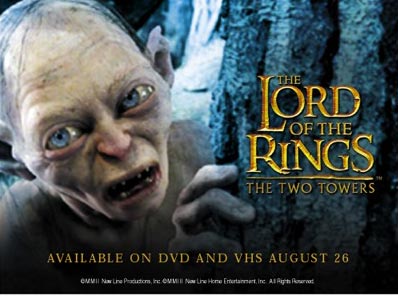
Tagline: A New Power Is Rising.
The Two Towers is grand, terrifying, and epic on a biblical level
The opening scene of The Two Towers provides an outstanding, yet very brief, taste of action, cinematography, and special effects, only to be matched (and far surpassed) in the final hour of the film. The stunning events of the third hour of The Two Towers are undoubtedly the centerpiece of the film, and while the first two hours serve finely as story development, they primarily build anticipation for the final hour, which mostly depicts the battle of Helm's Deep. More than anything else, the first two hours merely tease and torment the patient audience. It's a shame that such a gap has to exist between the first minute and the final hour, but I take no reservations in saying that despite how you feel about the first two hours of the film, the final hour will make the wait entirely worth its while.
As stated, the road to the battle of Helm's Deep can be enormously long and painful for any viewer aware of what breathtaking scenes await towards the end of the film. Perhaps The Two Towers' biggest fault is in its own accomplishments; the first two thirds of the film are well shot, well paced, and they necessarily and adequately progress the storyline, but when compared to the spectacular final hour, the first two hours seem uneventful and insignificant. However, to be fair, I feel that it's simply impossible to create two hours of film that could appropriately lead into the battle of Helm's Deep. It's difficult to comprehend how such scenes came to exist in the rather short amount of time Peter Jackson has had to create six hours (so far) of finished film. The battle of Helm's Deep is simply unreal; it's unlike any event that has come to pass since fantasy films gained, and regained, popularity.As assumed, The Two Towers begins where The Fellowship of the Ring ended.
The majority of the film follows four separate groups and their story lines: Frodo and Sam; Aragorn and Legolas, Merry and Pippin, and Saruman and his army. The performances live well up to the standards of the first film, with a particularly notable performance from Viggo Mortensen as Aragorn, whose role is significantly larger in The Two Towers. Aragorn satisfies a thirst for someone to root for, a thirst that was left partly unquenched in Fellowship. It's much easier to root for Aragorn than it is for Frodo; Aragorn has many more qualities of a leading man, a soldier, and a hero. More than once did the audience, filled mostly with academy voters, applaud the heroics of Aragorn.
Gollum also shines in a much-welcomed large role, due to extremely realistic computer animation, and a fine performance from Andy Serkis, upon which the animation was modeled. In Fellowship, it was appropriate to consider Gollum one of the many great 'features' of the film. However, here he is more of a leading character and a 'star,' and his convincing dual-personality, stabbing voice, and well-choreographed body movements make him consistently eye-grabbing and the center of focus of nearly every scene in which he appears.
As was The Fellowship of the Ring, The Two Towers is a visual delight. Those who have seen Fellowship are no doubt familiar with the beauty of the landscapes of New Zealand. The cinematography is, again, one of the best aspects of the film. The swooshing camera movements that follow the armies and horsemen throughout the fields are extremely satisfying in this post-Matrix era. The shots of the ascending enemy-laden ladders in the battle of Helm's Deep are terrifying and chillingly gorgeous all at once. The visual effects take an appropriate leap forward from those of the first film. While the visual effects in Fellowship were outstanding, the battle of Helm's Deep provides for the best application of CGI since the rippling waves of The Matrix's 'Bullet Time.' The battle of Helm's Deep features absolutely awe-inspiring and seamless integration of acting, stunts, and computer animation. Each orc seems to have its own personality, demonstrated in its movements and visual features. The masses of armies fight with strategy and true character, which I imagine is much harder to accomplish than animating thousands of identical clone troopers. The only problem I have with the visual department is the look of Treebeard, the Ent. Gimli's visual features seem a bit childish and uninspired, inconsistent with the standards set by the rest of the film.
But again, there is simply nothing that compares to the battle of Helm's Deep. George Lucas and the Wachowski brothers certainly have not created anything that approaches the grandness and magnificence of The Two Towers' final hour, and I doubt they will do so anytime soon.In The Fellowship of the Ring, there were a few minor problems with Howard Shore's musical score. While I thought it was gorgeous and it established several very memorable themes, I don't think it handled the sentimental scenes (opening in the Shire, Gandalf's passing) properly. I thought it caved in to the melodrama a bit too much, resembling the emotions from James Horner's Titanic, though much better than that. However, I believe that The Two Towers requires the type of score which Howard Shore accomplishes best: dark, continuous, and unrelenting, as demonstrated in Se7en and Silence of the Lambs. The theme used in many of the action scenes in Fellowship (low brass, six notes repeated with a rest in between) is much more present in The Two Towers, appropriately.
A brand new theme is also unveiled, the theme for Rohan, a prominent kingdom in Middle Earth. Rohan's theme is played more often than any other melody in the film, underscoring most of the memorable and heroic scenes with great effect. Howard Shore undeniably exhibits his skills as an 'A-list' composer, and with a possible double Oscar nomination this year for The Two Towers and Gangs of New York, he could get propelled to the very top of the 'A-list,' right beside John Williams and Hans Zimmer in terms of demand.If not the picture itself, there should be a way to recognize and award the battle of Helm's Deep. The battle sequence alone represents successful filmmaking in its highest form. The choreography of the battle, the visual effects, the pacing, acting, cinematography, and music, all work together in perfection to achieve grand filmmaking which is as entertaining and enjoyable as film can be. For this very reason, no one, whether a fan of Fellowship or not, should miss The Two Towers.
Awards: Won 2 Oscars. Another 57 wins & 71 nominations
yours truly,
91
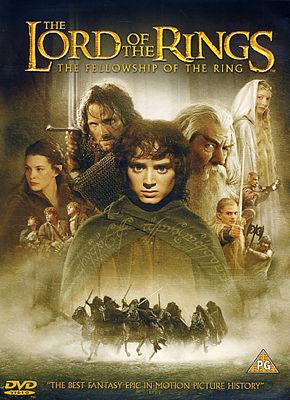
Tagline: The Legend Comes to Life
Embrace the magic
It is with no surprise that Peter Jackson's The Fellowship of the Ring film has received such mixed critics. Many viewers refer to it as being childish, boring and uninteresting. Seems to me that it is bound to the same fate of Tolkien's books, destined to be a target for the same type of misunderstandings that keep attacking this literary masterpiece many decades after it's first publication.Having read the books several years ago, I went to see this `impossible' film when it came out with many doubts on my mind. I really liked it, but left the theater with as many doubts as I had before. Was it perfect? Well, maybe not, but what an achievement. After watching it a few times on DVD, and thinking about it for some time now, I find myself loving this film more and more.
Let me tell you why...The Lord of the Rings is a fairy-tale of myth and fantasy. Peter Jackson directed a film that was considered, for a very long time, impossible to make, and not only for technical reasons. The narrative roots are incredibly long and detailed, and the storyline is deeply connected with the creation of a fantastic continent from a time unknown called `Middle Earth'. It's author, Tolkien, dedicated a considerable part of his life developing this continent's background, it's mythology and origins, it's different kinds of people, cultures and languages, and therefore it's geographic references are determinant to the unfolding of the story of the One Ring.Peter Jackson went out to achieve the impossible and came out with a recreation of the original that is pure and true to the story in every detail. The first time the four hobbits meet a black rider on the road, for example, is absolutely faithful to the feeling of the book. The assault of the riders at Weathertop is another great example, and it captures that feeling of danger, density and atmosphere that are the main characteristics of the tale.
Jackson also took some liberties with the story, and made some right choices along the way. If the so called `purists' may not approve the removal of Tom Bombadil altogether, it should be comprehensible that the travel from Hobbiton to Rivendel is a very long and detailed one and could easily make a movie on it's own. I felt more uneasy with how short the Council of Elrond was. In the book, the council is where the whole story of the rings is first explained, and many passages from the past ages of Middle Earth are unveiled. It is a fascinating moment of the story, that had to be shortened for obvious reasons. Still, after some consideration, I now agree with the options made by Peter Jackson, and think that the movie prologue narrated by Galadriel was the wisest choice. The magic is all there when Gandalf shuts his eyes the moment Frodo stands in the council and says `I will take the ring'. It is there at Moria's Gate, and at the fall of Boromir. It is a powerful film that doesn't fit the rhythm of the standard Hollywood action movie. It is a film that breeds, that takes time to unfold, it's tale branching in every direction.I could go on and on, talking about all the different elements that bring this film close to perfection, but I'll end saying that deep down, this is not about action, beards and big monsters. The greatest thing about this film, to me, is that it brought me back to a time when I was in love with a different world where everything was possible. Reading The Lord of the Rings night after night, I came to understand what this thing of `mankind' really was all about. The corruption of absolute power, the importance and value of friendship, the inevitability of growing up, the strength of hope... That this film could capture that magic, and be a new bearer to it's message of humanism, is a statement to it's greatness. Gandalf's words, that even the smallest person may change the course of the world, and have a part to play in the destiny of all, are immortal.
In the end, this is a wonderful film, but that doesn't mean you are going to like it. I cannot tell you what it is like to see this film if you don't know or love the book. But I hope it may plant a seed on your heart to discover a great world of fantasy, beauty and humanity. I believe Tolkien would have liked that.
Awards: Won 4 Oscars. Another 68 wins & 81 nominations
yours truly,91